
Company Overview
At Pipe and Sections Pvt Ltd, we help contractors, builders, dealers, and project buyers get the latest tmt saria rate, transparent quotations, and fast delivery across India.
Most Recent Posts
- All Posts
- TMT Bars


Tags
What Does Fe 500, Fe 550 & Fe 600 Mean in TMT Bars?
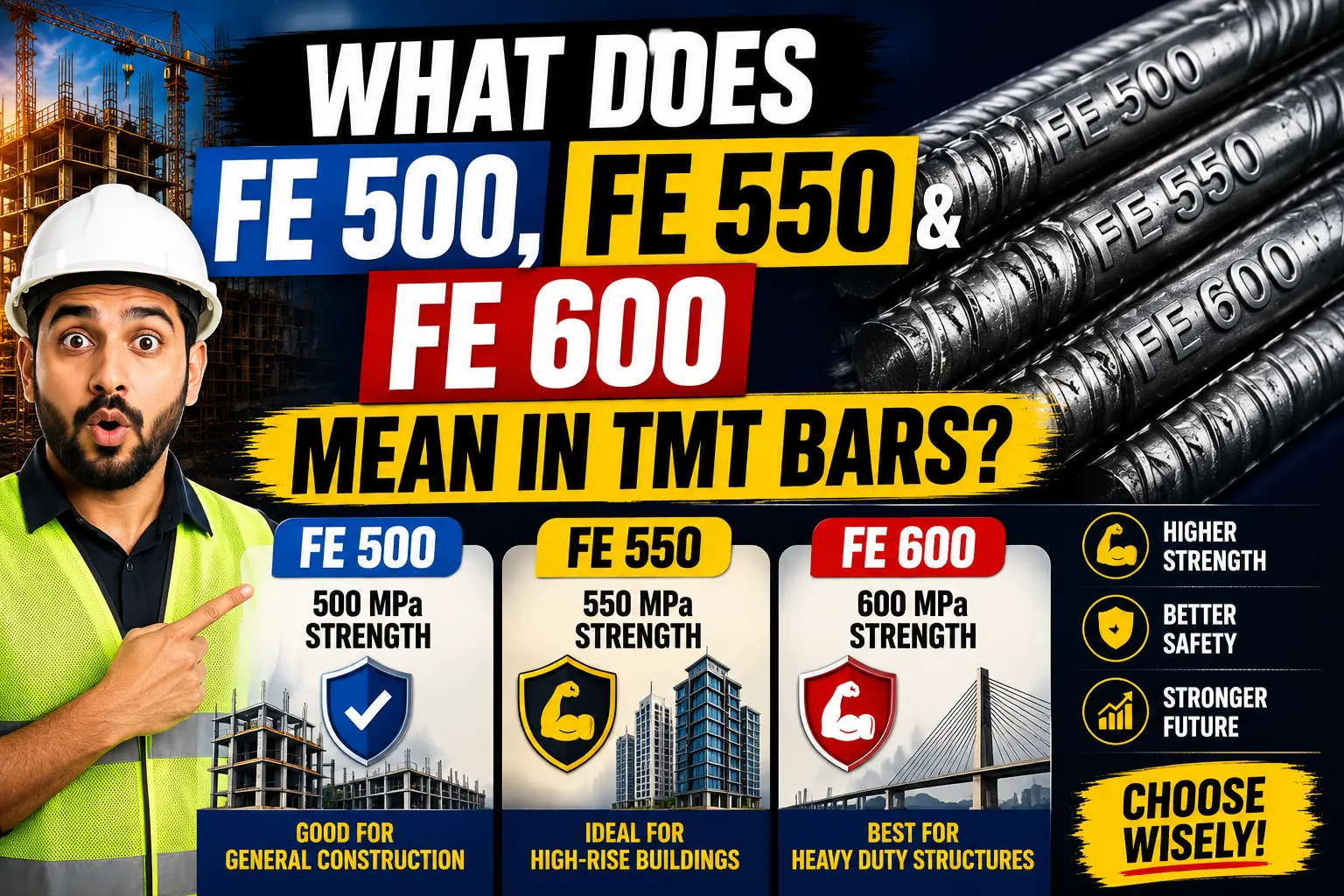
Fe 500, Fe 550, and Fe 600 are strength grades used in TMT bars that indicate the minimum yield strength of steel measured in megapascals (MPa). Fe 500 TMT bars provide a minimum yield strength of 500 MPa, while Fe 550 and Fe 600 offer even higher strength for heavy construction and infrastructure projects. Understanding these TMT grades is essential for selecting the right steel for residential houses, commercial buildings, bridges, industrial structures, and earthquake-resistant construction. The correct TMT grade directly affects structural safety, durability, flexibility, and overall construction cost.
What Does “Fe” Mean in TMT Bars?
The term “Fe” in TMT bars stands for iron. It is derived from the Latin word Ferrum, which is the scientific symbol for iron in the periodic table.
In the Indian steel industry, TMT bars are classified according to BIS (Bureau of Indian Standards) guidelines under IS 1786 standards. The “Fe” designation helps identify the strength category of reinforcement steel bars used in RCC construction.
For example:
- Fe 500 = Iron reinforcement steel with 500 MPa minimum yield strength
- Fe 550 = Iron reinforcement steel with 550 MPa minimum yield strength
- Fe 600 = Iron reinforcement steel with 600 MPa minimum yield strength
This classification helps contractors, engineers, architects, and builders choose the correct reinforcement material based on structural requirements.
What Does the Number 500, 550 & 600 Mean?
The numbers 500, 550, and 600 indicate the minimum yield strength of TMT bars measured in megapascals (MPa).
Yield strength refers to the amount of stress a steel bar can withstand before it starts permanently deforming.
- Fe 500 = 500 MPa
- Fe 550 = 550 MPa
- Fe 600 = 600 MPa
Higher numbers indicate stronger TMT bars with greater load-bearing capacity.
Yield Strength (MPa)=ForceCross Sectional Area\text{Yield Strength (MPa)}=\frac{\text{Force}}{\text{Cross Sectional Area}}Yield Strength (MPa)=Cross Sectional AreaForce
This formula explains how much force a TMT bar can resist per unit area before bending or deforming permanently.
The higher the yield strength:
- The stronger the reinforcement
- The lower the steel quantity required
- The better the load-handling capacity
However, higher strength does not always mean better flexibility or earthquake resistance.
Understanding Yield Strength in TMT Bars
Yield strength is one of the most important mechanical properties of reinforcement steel.
It defines the stress level at which steel starts losing its elastic behavior and undergoes permanent deformation.
Why Yield Strength Matters in Construction
Yield strength directly affects:
- Structural stability
- Load-bearing capacity
- Beam and column performance
- Earthquake resistance
- Long-term durability
When the applied load exceeds the yield point, the steel starts bending permanently and cannot return to its original shape.
In RCC structures, proper yield strength ensures:
- Better crack resistance
- Higher structural safety
- Improved lifespan
- Better load distribution
This is why engineers carefully select TMT grades according to building design and structural calculations.
Fe 500 TMT Bars Explained
What is Fe 500 TMT Bar?
Fe 500 is one of the most commonly used TMT bar grades in India for residential and commercial construction.
It offers a balanced combination of:
- Strength
- Flexibility
- Weldability
- Cost-effectiveness
Fe 500 bars are suitable for most standard RCC structures.
Yield Strength of Fe 500
Fe 500 TMT bars have a minimum yield strength of 500 MPa.
This means the steel can withstand 500 megapascals of stress before permanent deformation starts.
Typical properties include:
- High tensile strength
- Good elongation
- Better bonding with concrete
- Suitable ductility for residential structures
Applications of Fe 500 Bars
Fe 500 bars are widely used in:
- Residential houses
- RCC slabs
- Columns
- Beams
- Footings
- Low-rise buildings
- Apartments
- Schools and offices
It is considered the standard grade for most home construction projects in India.
Advantages of Fe 500
Balanced Strength
Fe 500 provides excellent strength without compromising flexibility.
Cost-Effective
It is affordable and suitable for most residential budgets.
Easy Availability
Fe 500 bars are easily available across India.
Suitable for Most Houses
Most engineers recommend Fe 500 for residential structures due to its balance between strength and ductility.
You can also read Best TMT Bar for House Construction before finalizing steel grades for your project.
Fe 500 vs Fe 500D
The “D” in Fe 500D stands for ductility.
Key Difference
| Property | Fe 500 | Fe 500D |
|---|---|---|
| Strength | High | High |
| Ductility | Moderate | Higher |
| Elongation | Lower | Higher |
| Earthquake Resistance | Good | Better |
Fe 500D bars provide better elongation and flexibility, making them more suitable for earthquake-prone areas.
Fe 550 TMT Bars Explained
What is Fe 550 TMT Bar?
Fe 550 TMT bars are high-strength reinforcement bars designed for heavy-load structures.
They offer higher yield strength than Fe 500 bars and are commonly used in commercial and industrial construction.
Yield Strength of Fe 550
Fe 550 bars have a minimum yield strength of 550 MPa.
This increased strength allows engineers to reduce steel quantity while maintaining structural performance.
Applications of Fe 550
Fe 550 bars are commonly used in:
- Commercial buildings
- Industrial sheds
- Warehouses
- Bridges
- Flyovers
- Heavy RCC structures
- Multi-storey buildings
Advantages of Fe 550
Higher Load Capacity
Fe 550 can handle heavier structural loads compared to Fe 500.
Reduced Steel Consumption
Higher strength means less steel may be required in certain structural designs.
Stronger Structures
Fe 550 bars improve overall structural integrity in large-scale projects.
Fe 550 vs Fe 550D
Fe 550D offers better ductility and seismic resistance than standard Fe 550 bars.
| Property | Fe 550 | Fe 550D |
|---|---|---|
| Yield Strength | 550 MPa | 550 MPa |
| Flexibility | Moderate | Higher |
| Elongation | Lower | Higher |
| Seismic Performance | Good | Better |
Fe 550D is preferred in earthquake zones and heavy structural applications.
Fe 600 TMT Bars Explained
What is Fe 600 TMT Bar?
Fe 600 TMT bars are ultra-high-strength reinforcement bars used in infrastructure and industrial mega projects.
These bars are designed for structures requiring extremely high load-bearing capacity.
Yield Strength of Fe 600
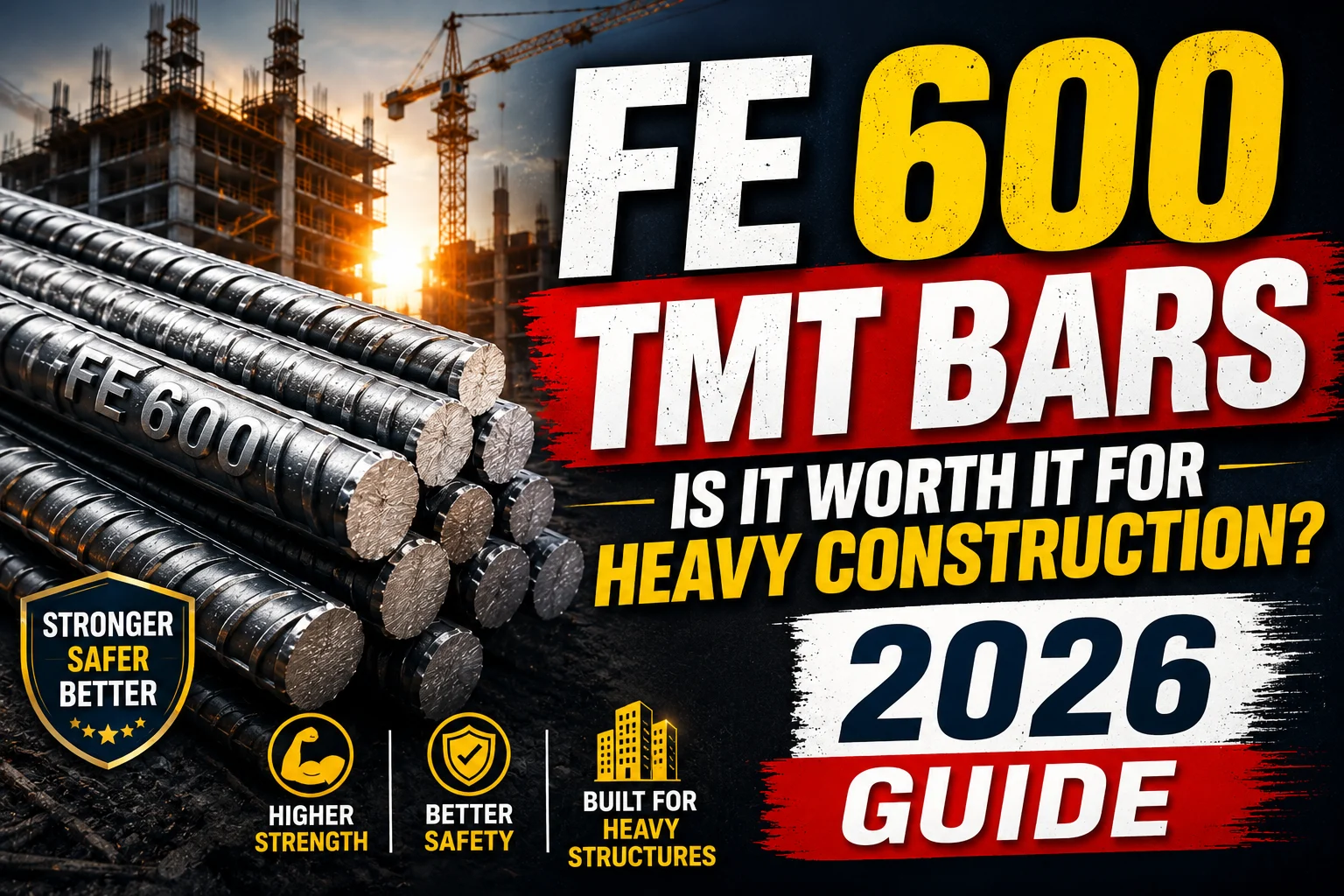
Fe 600 bars provide a minimum yield strength of 600 MPa.
This makes them among the strongest TMT reinforcement bars used in construction.
Applications of Fe 600
Fe 600 bars are used in:
- Metro rail projects
- Dams
- High-rise towers
- Industrial plants
- Mega infrastructure
- Heavy engineering projects
- Power plants
- Large commercial complexes
Advantages of Fe 600
Ultra High Strength
Fe 600 offers excellent load resistance for demanding projects.
Lower Steel Quantity
Higher strength allows optimized steel usage.
Better Structural Performance
Fe 600 bars improve performance in high-load structures.
Fe 500 vs Fe 550 vs Fe 600 – Complete Comparison
| Property | Fe 500 | Fe 550 | Fe 600 |
|---|---|---|---|
| Yield Strength | 500 MPa | 550 MPa | 600 MPa |
| Ductility | High | Moderate | Lower |
| Cost | Moderate | Higher | Highest |
| Applications | Residential | Commercial | Infrastructure |
| Flexibility | Better | Moderate | Lower |
| Earthquake Resistance | Excellent (500D) | Good (550D) | Moderate |
| Weldability | Good | Good | Specialized |
| Steel Consumption | Higher | Reduced | Lowest |
This table clearly explains the difference between Fe 500 vs Fe 550 vs Fe 600 TMT bars.
Which TMT Grade is Best for House Construction?
For most residential houses, Fe 500 or Fe 500D is considered the best choice.
Why Fe 500 is Preferred
- Balanced strength and ductility
- Better earthquake resistance
- Cost-effective
- Easy bending and fabrication
- Suitable for slabs, beams, and columns
When to Use Fe 550
Fe 550 may be used in:
- Premium villas
- High-load residential structures
- Multi-storey buildings
When to Use Fe 600
Fe 600 is generally unnecessary for standard homes because excessive strength without adequate ductility may not provide practical benefits in residential construction.
You can also check our TMT Bar Price List Today for the latest Fe 500, Fe 550, and Fe 600 rates.
Which TMT Grade is Best for Earthquake Zones?
In seismic areas, ductility is more important than only high strength.
Ductile bars absorb seismic energy better and reduce sudden structural failure.
Recommended Grades
- Fe 500D
- Fe 550D
These grades offer:
- Better elongation
- Improved flexibility
- Enhanced seismic resistance
Fe 500D is widely recommended for earthquake-prone regions because of its excellent balance between strength and ductility.
Difference Between Strength & Ductility
Many people confuse strength with ductility, but both properties are different.
Strength
Strength refers to the load a TMT bar can withstand.
Ductility
Ductility refers to the ability of steel to bend or stretch before breaking.
Ductility=Final Length−Original LengthOriginal Length×100\text{Ductility}=\frac{\text{Final Length}-\text{Original Length}}{\text{Original Length}}\times100Ductility=Original LengthFinal Length−Original Length×100
Higher ductility means:
- Better earthquake resistance
- Reduced sudden failure
- Improved structural flexibility
This is why ductile grades like Fe 500D are often preferred over ultra-high-strength bars for residential projects.
BIS Standards for TMT Bar Grades
TMT bars in India are governed by IS 1786 standards issued by BIS (Bureau of Indian Standards).
These standards define:
- Yield strength
- Tensile strength
- Elongation limits
- Chemical composition
- Bend and rebend properties
Importance of BIS Certification
BIS-certified bars ensure:
- Standardized quality
- Proper strength
- Better durability
- Reliable construction safety
Always check for:
- BIS logo
- ISI mark
- Grade marking
- Manufacturer embossing
before purchasing TMT bars.
How TMT Grade Affects Construction Cost
The grade of TMT bars directly impacts project cost.
Steel Consumption
Higher grades may reduce steel quantity requirements.
Labor Efficiency
Higher-quality bars improve fabrication and bending performance.
Structural Efficiency
Optimized structural design can reduce overall RCC volume.
Overall Project Cost
Although Fe 550 and Fe 600 may cost more per ton, they can reduce total reinforcement quantity in heavy structures. However, for standard residential houses, Fe 500 usually provides the best cost-performance balance.
How to Identify Genuine Fe 500, Fe 550 & Fe 600 Bars
Counterfeit or substandard steel can seriously affect structural safety.
Check Embossing Marks
Original bars contain:
- Grade marking
- Manufacturer name
- BIS code
Verify BIS Certification
Always check the BIS logo and ISI certification.
Request Test Certificates
Manufacturers provide lab test reports for:
- Yield strength
- Tensile strength
- Chemical composition
Buy from Trusted Suppliers
Always purchase from reliable steel dealers and authorized distributors.
You should also read How to Check TMT Bar Quality before buying reinforcement steel.
Best Applications for Different TMT Grades
| Construction Type | Recommended Grade |
|---|---|
| Residential House | Fe 500 |
| Commercial Building | Fe 550 |
| Industrial Project | Fe 600 |
| Earthquake Zone | Fe 500D |
| Bridges | Fe 550D / Fe 600 |
| Metro & Infrastructure | Fe 600 |
| RCC Slabs & Columns | Fe 500 |
Common Myths About Higher TMT Grades
Myth 1: Higher Grade Always Means Better
Wrong. Higher strength does not always mean better structural performance.
Myth 2: Fe 600 is Best for Every House
Fe 600 may not provide the required ductility for residential structures.
Myth 3: Stronger Bars Eliminate Structural Design
Even the strongest steel cannot replace proper RCC design and engineering calculations.
Why Contractors Prefer Fe 500 & Fe 550
Most contractors prefer Fe 500 and Fe 550 because they offer the best balance between performance and cost.
Cost-Performance Balance
Suitable for most projects without excessive steel costs.
Easy Bending
These grades are easier to fabricate at construction sites.
Better Weldability
Good welding properties simplify reinforcement work.
High Availability
Fe 500 and Fe 550 are widely available across Indian markets.
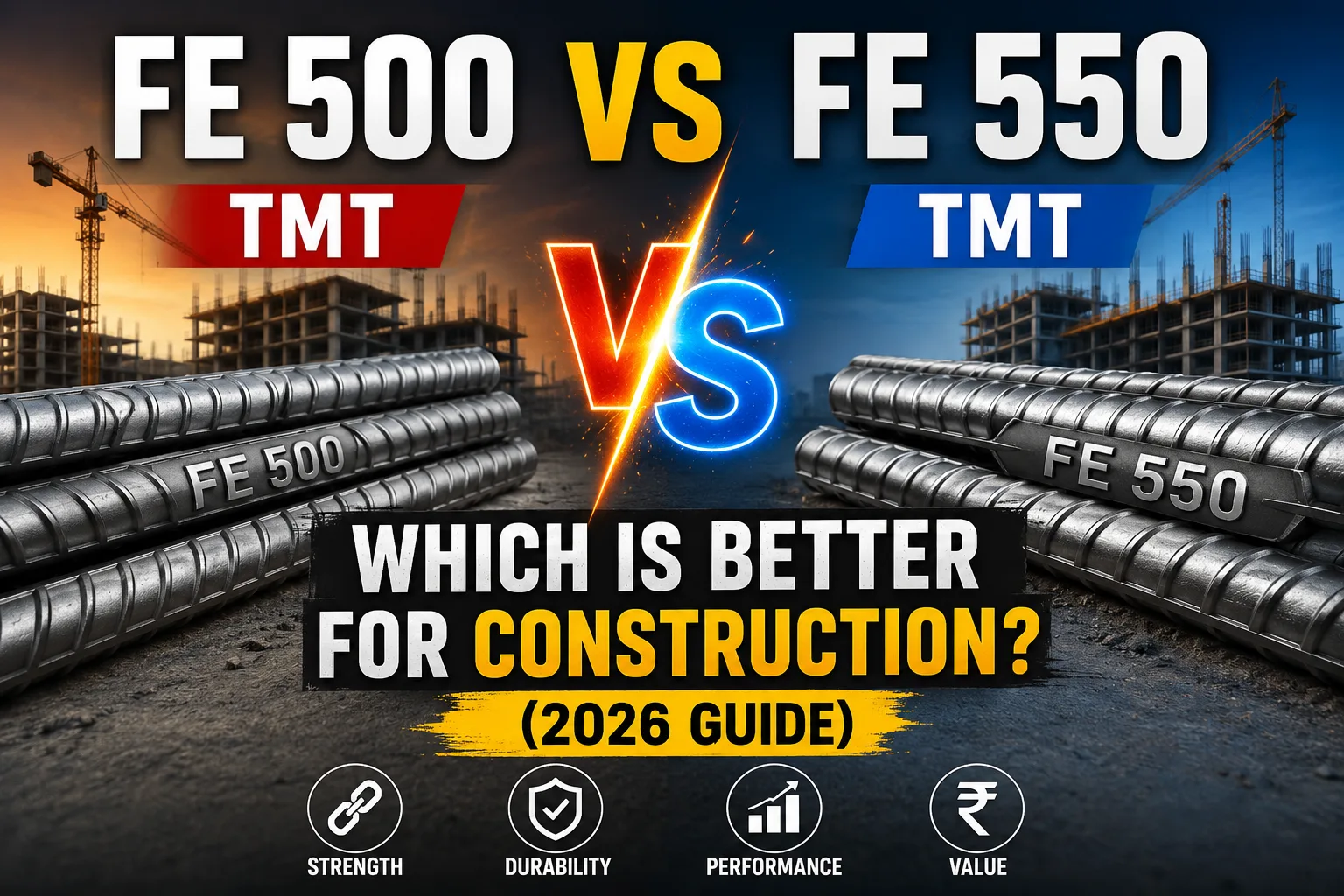
You can also explore Fe 500 vs Fe 550 TMT Bars for a detailed comparison.
Latest TMT Bar Prices by Grade
TMT bar prices vary according to:
- Steel market demand
- Raw material costs
- Brand
- Grade
- Transportation
- Regional supply
Fe 500 Price Trend
Fe 500 remains the most competitively priced and widely used grade.
Fe 550 Premium Pricing
Fe 550 generally costs slightly higher because of increased strength properties.
Fe 600 Industrial Demand
Fe 600 bars are usually premium-priced due to specialized industrial applications.
For updated market rates, check our TMT Bar Price List Today.
Final Conclusion
Understanding the meaning of Fe 500, Fe 550, and Fe 600 TMT bars is extremely important for selecting the right reinforcement steel for any construction project. These grades indicate the yield strength and overall structural capability of TMT bars.
- Fe 500 is ideal for residential houses
- Fe 550 is suitable for commercial and heavy structures
- Fe 600 is designed for mega infrastructure and industrial projects
Choosing the correct TMT grade improves structural safety, durability, earthquake resistance, and long-term construction performance. Engineers, contractors, architects, and builders should always select TMT grades according to project load requirements, ductility needs, and BIS standards.
Before purchasing reinforcement steel, also read:
Frequently Asked Questions
What does Fe 500 mean in TMT bars?
Fe 500 means the TMT bar has a minimum yield strength of 500 MPa.
Which is stronger: Fe 500 or Fe 550?
Fe 550 is stronger because it offers higher yield strength than Fe 500.
Is Fe 600 good for house construction?
Fe 600 is generally used for heavy infrastructure projects rather than standard residential houses.
What is the yield strength of Fe 500 bars?
Fe 500 bars have a minimum yield strength of 500 MPa.
Which TMT grade is best for earthquake-prone areas?
Fe 500D and Fe 550D are considered best for seismic zones due to higher ductility.
What is the difference between Fe 500 and Fe 500D?
Fe 500D provides higher ductility and elongation compared to standard Fe 500 bars.
Are Fe 550 bars more expensive than Fe 500?
Yes, Fe 550 bars usually cost more because of their higher strength properties.
Which TMT bar grade is most commonly used in India?
Fe 500 is the most commonly used TMT bar grade for residential and commercial construction.
Strength, reliability, and excellence in every steel pipe and section we supply for your growth.
- +91 9310020802
- [email protected]
- 22 & 23, Apollo Market, Prakash Industrial Estate, Sahibabad - 201005, Ghaziabad (U.P.) INDIA.
Work Hours
- Mon-Sat 10:00AM -6:00PM
Explore the premium range of TMT bars from Pipe & Sections, engineered with advanced technology to deliver superior strength, exceptional durability.
© 2026 All Rights Reserved. Designed and Managed by SBS DIGITAL INFOTECH.