
What Does Fe 500, Fe 550 & Fe 600 Mean in TMT Bars?
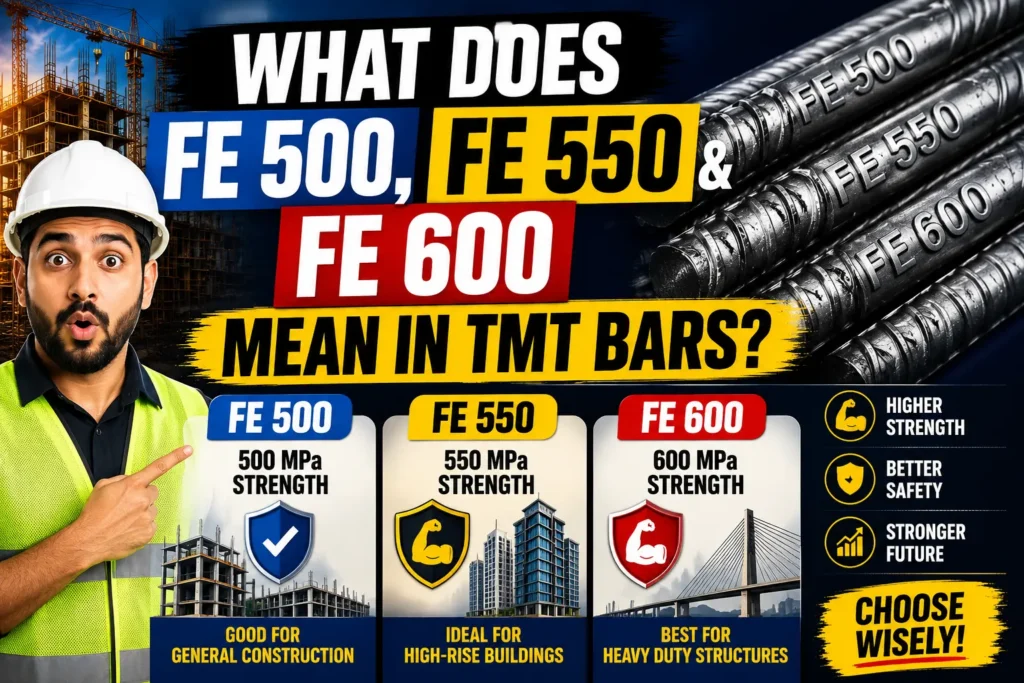
+91-9310020802 [email protected] Get A Quote Edit Template Home About us Products Contact us Latest Blogs Privacy Policy Home About us Products Contact us Latest Blogs Privacy Policy Facebook-f X-twitter Instagram Linkedin Company Overview At Pipe and Sections Pvt Ltd, we help contractors, builders, dealers, and project buyers get the latest tmt saria rate, transparent quotations, and fast delivery across India. Most Recent Posts All Posts TMT Bars What Does Fe 500, Fe 550 & Fe 600 Mean in TMT Bars? May 19, 2026/Read More How Much TMT Steel is Required for a 1000 Sq Ft House? May 19, 2026/Read More How to Reduce Construction Cost with the Right TMT Bars (2026 Guide) May 18, 2026/Read More TMT Bars for High-Rise Buildings: Best Grades & Sizes May 18, 2026/Read More Best TMT Bars for Earthquake Resistant Construction (2026 Guide) May 18, 2026/Read More Which TMT Bar is Best for RCC Construction? (2026 Guide) May 16, 2026/Read More Primary vs Secondary TMT Bars: What’s the Difference? May 15, 2026/Read More TMT Buying Guide for Contractors (2026) Fe 500, Fe 550, Fe 500D, Fe 550D, Fe 600. May 15, 2026/Read More Why TMT Prices Change Daily in India May 15, 2026/Read More How to Check TMT Bar Quality Before Buying May 13, 2026/Read More Best TMT Bar for House Construction in India (2026 Guide) May 9, 2026/Read More Fe 500 vs Fe 550 TMT: Which is Better for Construction? (2026 Guide) May 9, 2026/Read More TMT Bar Sizes Explained (8mm to 32mm Full Guide) May 8, 2026/Read More Fe 600 TMT Bars: Is It Worth It for Heavy Construction? (2026 Guide) May 7, 2026/Read More Load More End of Content. Tags TMT Bars (19) What Does Fe 500, Fe 550 & Fe 600 Mean in TMT Bars? Fe 500, Fe 550, and Fe 600 are strength grades used in TMT bars that indicate the minimum yield strength of steel measured in megapascals (MPa). Fe 500 TMT bars provide a minimum yield strength of 500 MPa, while Fe 550 and Fe 600 offer even higher strength for heavy construction and infrastructure projects. Understanding these TMT grades is essential for selecting the right steel for residential houses, commercial buildings, bridges, industrial structures, and earthquake-resistant construction. The correct TMT grade directly affects structural safety, durability, flexibility, and overall construction cost. What Does “Fe” Mean in TMT Bars? The term “Fe” in TMT bars stands for iron. It is derived from the Latin word Ferrum, which is the scientific symbol for iron in the periodic table. In the Indian steel industry, TMT bars are classified according to BIS (Bureau of Indian Standards) guidelines under IS 1786 standards. The “Fe” designation helps identify the strength category of reinforcement steel bars used in RCC construction. For example: Fe 500 = Iron reinforcement steel with 500 MPa minimum yield strength Fe 550 = Iron reinforcement steel with 550 MPa minimum yield strength Fe 600 = Iron reinforcement steel with 600 MPa minimum yield strength This classification helps contractors, engineers, architects, and builders choose the correct reinforcement material based on structural requirements. What Does the Number 500, 550 & 600 Mean? The numbers 500, 550, and 600 indicate the minimum yield strength of TMT bars measured in megapascals (MPa). Yield strength refers to the amount of stress a steel bar can withstand before it starts permanently deforming. Fe 500 = 500 MPa Fe 550 = 550 MPa Fe 600 = 600 MPa Higher numbers indicate stronger TMT bars with greater load-bearing capacity. Yield Strength (MPa)=ForceCross Sectional Areatext{Yield Strength (MPa)}=frac{text{Force}}{text{Cross Sectional Area}}Yield Strength (MPa)=Cross Sectional AreaForce This formula explains how much force a TMT bar can resist per unit area before bending or deforming permanently. The higher the yield strength: The stronger the reinforcement The lower the steel quantity required The better the load-handling capacity However, higher strength does not always mean better flexibility or earthquake resistance. Understanding Yield Strength in TMT Bars Yield strength is one of the most important mechanical properties of reinforcement steel. It defines the stress level at which steel starts losing its elastic behavior and undergoes permanent deformation. Why Yield Strength Matters in Construction Yield strength directly affects: Structural stability Load-bearing capacity Beam and column performance Earthquake resistance Long-term durability When the applied load exceeds the yield point, the steel starts bending permanently and cannot return to its original shape. In RCC structures, proper yield strength ensures: Better crack resistance Higher structural safety Improved lifespan Better load distribution This is why engineers carefully select TMT grades according to building design and structural calculations. Fe 500 TMT Bars Explained What is Fe 500 TMT Bar? Fe 500 is one of the most commonly used TMT bar grades in India for residential and commercial construction. It offers a balanced combination of: Strength Flexibility Weldability Cost-effectiveness Fe 500 bars are suitable for most standard RCC structures. Yield Strength of Fe 500 Fe 500 TMT bars have a minimum yield strength of 500 MPa. This means the steel can withstand 500 megapascals of stress before permanent deformation starts. Typical properties include: High tensile strength Good elongation Better bonding with concrete Suitable ductility for residential structures Applications of Fe 500 Bars Fe 500 bars are widely used in: Residential houses RCC slabs Columns Beams Footings Low-rise buildings Apartments Schools and offices It is considered the standard grade for most home construction projects in India. Advantages of Fe 500 Balanced Strength Fe 500 provides excellent strength without compromising flexibility. Cost-Effective It is affordable and suitable for most residential budgets. Easy Availability Fe 500 bars are easily available across India. Suitable for Most Houses Most engineers recommend Fe 500 for residential structures due to its balance between strength and ductility. You can also read Best TMT Bar for House Construction before finalizing steel grades for your project. Fe 500 vs Fe 500D The “D” in Fe 500D stands for ductility. Key Difference Property Fe 500 Fe 500D Strength High High Ductility Moderate Higher Elongation Lower Higher Earthquake Resistance Good Better Fe 500D bars provide better elongation and flexibility, making them more suitable for earthquake-prone
How Much TMT Steel is Required for a 1000 Sq Ft House?
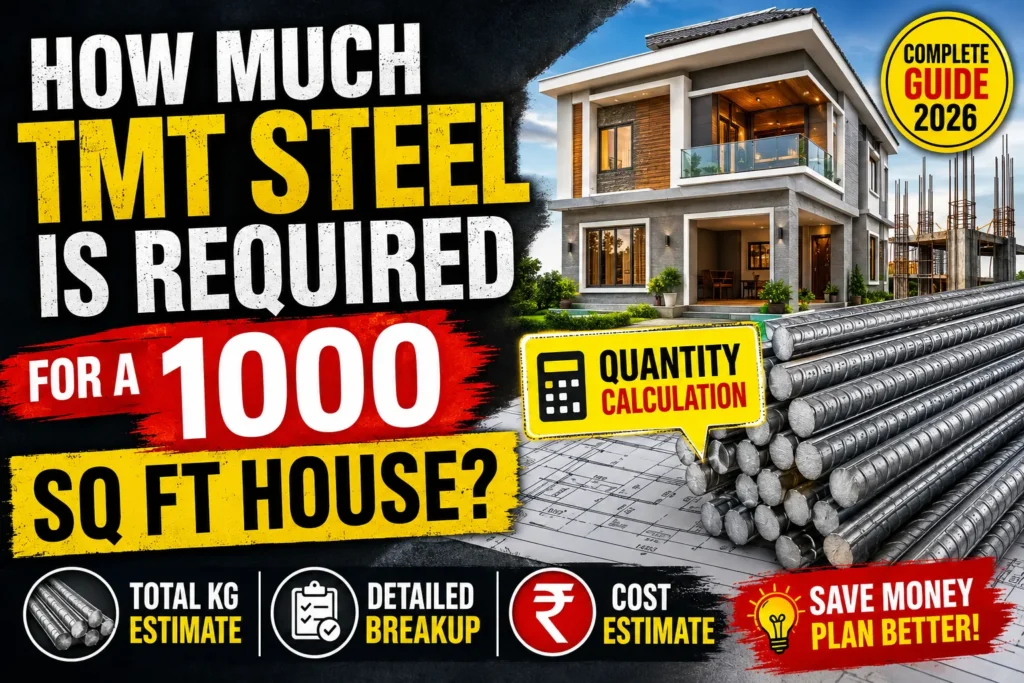
+91-9310020802 [email protected] Get A Quote Edit Template Home About us Products Contact us Latest Blogs Privacy Policy Home About us Products Contact us Latest Blogs Privacy Policy Facebook-f X-twitter Instagram Linkedin Company Overview At Pipe and Sections Pvt Ltd, we help contractors, builders, dealers, and project buyers get the latest tmt saria rate, transparent quotations, and fast delivery across India. Most Recent Posts All Posts TMT Bars How Much TMT Steel is Required for a 1000 Sq Ft House? May 19, 2026/Read More How to Reduce Construction Cost with the Right TMT Bars (2026 Guide) May 18, 2026/Read More TMT Bars for High-Rise Buildings: Best Grades & Sizes May 18, 2026/Read More Best TMT Bars for Earthquake Resistant Construction (2026 Guide) May 18, 2026/Read More Which TMT Bar is Best for RCC Construction? (2026 Guide) May 16, 2026/Read More Primary vs Secondary TMT Bars: What’s the Difference? May 15, 2026/Read More TMT Buying Guide for Contractors (2026) Fe 500, Fe 550, Fe 500D, Fe 550D, Fe 600. May 15, 2026/Read More Why TMT Prices Change Daily in India May 15, 2026/Read More How to Check TMT Bar Quality Before Buying May 13, 2026/Read More Best TMT Bar for House Construction in India (2026 Guide) May 9, 2026/Read More Fe 500 vs Fe 550 TMT: Which is Better for Construction? (2026 Guide) May 9, 2026/Read More TMT Bar Sizes Explained (8mm to 32mm Full Guide) May 8, 2026/Read More Fe 600 TMT Bars: Is It Worth It for Heavy Construction? (2026 Guide) May 7, 2026/Read More Fe 550D TMT Bars: Why Builders Prefer It (2026 Guide) May 6, 2026/Read More Load More End of Content. Tags TMT Bars (18) How Much TMT Steel is Required for a 1000 Sq Ft House? The amount of TMT steel required for a 1000 sq ft house typically ranges between 3.5 to 5 metric tons depending on the number of floors, structural design, soil condition, slab thickness, and beam-column layout. In India, most residential RCC structures consume around 4 kg to 5 kg of steel per square foot for a single-floor construction. However, duplex homes, earthquake-resistant structures, and heavy-load buildings may require higher steel consumption. In this guide, we explain complete TMT steel quantity calculations, slab-wise estimation, TMT bar sizes, steel weight charts, cost estimation, and practical construction tips for accurate material planning. Average TMT Steel Requirement for a 1000 Sq Ft House The total tmt steel required for 1000 sq ft house mainly depends on the structural system used in construction. A load-bearing structure uses less steel compared to a fully RCC-framed structure. For a standard residential house in India: House Type Steel Required Single Floor House 3.5 – 4 MT G+1 House 4 – 5 MT Heavy RCC Structure 5 – 6 MT Key Factors Affecting Average Steel Usage Number of floors Soil bearing capacity Earthquake zone Column spacing Slab thickness Architectural design complexity Load distribution A simple single-story house generally requires lower reinforcement, while duplex homes and commercial-style residential buildings require additional beams, columns, and slab reinforcement. You can also read TMT Bar Price Today to estimate the latest market pricing before purchasing steel. TMT Steel Calculation Formula The most common method used by civil engineers for estimating steel quantity is: Steel Quantity=Built Up Area×Steel Consumption Factortext{Steel Quantity} = text{Built Up Area} times text{Steel Consumption Factor}Steel Quantity=Built Up Area×Steel Consumption Factor Understanding the Formula Built-Up Area Built-up area includes: Carpet area Wall thickness Balcony area Staircase area Steel Consumption Factor This represents the average steel required per square foot. Typical consumption values: Residential house: 4–5 kg/sq ft Duplex structure: 5–6 kg/sq ft Commercial building: 6–8 kg/sq ft Example Calculation If the steel consumption is 4.5 kg/sq ft: 1000 × 4.5 = 4500 kg 4500 kg = 4.5 MT steel This method gives a quick estimation during initial planning. For better understanding of grades and structural performance, read Fe 500 TMT Bars Guide. TMT Steel Required Per Square Foot Steel consumption per square foot varies according to the structural load and building design. Construction Type Steel Consumption Residential House 4–5 kg/sq ft Duplex House 5–6 kg/sq ft Commercial Building 6–8 kg/sq ft Residential Structures Standard residential houses usually consume moderate quantities of steel because load distribution remains comparatively lower. Duplex & Multi-Storey Houses These require: Stronger columns Additional beams Higher reinforcement density Seismic Zone Buildings Houses constructed in earthquake-prone zones require additional reinforcement for safety and ductility. This directly increases the steel consumption in residential building projects. Floor-Wise TMT Steel Estimation for a 1000 Sq Ft House Different structural elements consume different quantities of TMT bars. Foundation Steel Quantity The foundation carries the entire structural load. Weak soil conditions require additional footing reinforcement. Approximate steel usage: 900–1200 kg Column Steel Quantity Columns are vertical load-bearing members. Approximate steel usage: 700–1000 kg Beam Steel Quantity Beams transfer slab load to columns. Approximate steel usage: 600–900 kg Slab Steel Quantity Slabs consume a significant quantity of reinforcement bars. Approximate steel usage: 1200–1600 kg Staircase Steel Quantity Staircases require additional reinforcement for bending resistance. Approximate steel usage: 150–300 kg Detailed Steel Quantity Table Structure Part Approx Steel Quantity Foundation 1000 kg Columns 850 kg Beams 750 kg Slab 1400 kg Staircase 200 kg Total Approximation: 4200 kg to 5000 kg This is a standard range for a typical RCC residential structure. TMT Bar Sizes Used in House Construction Different bar diameters are used for different structural members. TMT Bar Size Common Use 8mm Slabs 10mm Slabs & Stirrups 12mm Beams 16mm Columns 20mm Heavy Load Structures 8mm TMT Bars Mostly used in: Slab mesh Distribution bars 10mm TMT Bars Used for: Slabs Stirrups Small beams 12mm TMT Bars Common in: Residential beams Moderate load sections 16mm TMT Bars Preferred for: Columns High-load structural areas 20mm TMT Bars Used in: Heavy RCC structures Multi-storey buildings You can compare grades and strength differences in Fe 550 vs Fe 500 TMT Bars. Best TMT Grade for 1000 Sq Ft House Construction Choosing the right TMT grade directly impacts durability and structural strength. Fe 500 TMT Bars High tensile strength Cost-effective Ideal for residential
How to Reduce Construction Cost with the Right TMT Bars (2026 Guide)
+91-9310020802 [email protected] Get A Quote Edit Template Home About us Products Contact us Latest Blogs Privacy Policy Home About us Products Contact us Latest Blogs Privacy Policy Facebook-f X-twitter Instagram Linkedin Company Overview At Pipe and Sections Pvt Ltd, we help contractors, builders, dealers, and project buyers get the latest tmt saria rate, transparent quotations, and fast delivery across India. Most Recent Posts All Posts TMT Bars What Does Fe 500, Fe 550 & Fe 600 Mean in TMT Bars? May 19, 2026/Read More How Much TMT Steel is Required for a 1000 Sq Ft House? May 19, 2026/Read More How to Reduce Construction Cost with the Right TMT Bars (2026 Guide) May 18, 2026/Read More TMT Bars for High-Rise Buildings: Best Grades & Sizes May 18, 2026/Read More Best TMT Bars for Earthquake Resistant Construction (2026 Guide) May 18, 2026/Read More Which TMT Bar is Best for RCC Construction? (2026 Guide) May 16, 2026/Read More Primary vs Secondary TMT Bars: What’s the Difference? May 15, 2026/Read More TMT Buying Guide for Contractors (2026) Fe 500, Fe 550, Fe 500D, Fe 550D, Fe 600. May 15, 2026/Read More Why TMT Prices Change Daily in India May 15, 2026/Read More How to Check TMT Bar Quality Before Buying May 13, 2026/Read More Best TMT Bar for House Construction in India (2026 Guide) May 9, 2026/Read More Fe 500 vs Fe 550 TMT: Which is Better for Construction? (2026 Guide) May 9, 2026/Read More TMT Bar Sizes Explained (8mm to 32mm Full Guide) May 8, 2026/Read More Fe 600 TMT Bars: Is It Worth It for Heavy Construction? (2026 Guide) May 7, 2026/Read More Load More End of Content. Tags TMT Bars (19) How to Reduce Construction Cost with the Right TMT Bars Construction cost can be significantly reduced by selecting the right TMT bar grade, optimizing steel weight calculations, avoiding material wastage, and sourcing from reliable bulk suppliers. Choosing suitable TMT bars for your project improves structural efficiency, lowers unnecessary steel consumption, and helps contractors manage long-term project costs without compromising safety. Why TMT Bar Selection Directly Impacts Construction Cost Steel reinforcement is one of the most expensive components in residential, commercial, and infrastructure construction projects. In most RCC structures, TMT bars account for a major percentage of the structural material budget. Even a small mistake in TMT selection can increase overall project costs significantly. Many builders and contractors focus only on the per-ton rate while buying steel, but actual construction cost depends on several other factors: Correct TMT grade selection Weight optimization Structural compatibility Material wastage control Bulk procurement planning Transportation efficiency Quality consistency Using the wrong TMT bars can lead to: Higher steel consumption Increased dead load Structural redesign costs Additional labor expenses Material wastage Long-term maintenance issues This is why contractors and project buyers now focus on smart steel procurement strategies instead of simply purchasing the cheapest available material. For buyers planning residential or commercial projects, reading the Ultimate TMT Buying Guide for Construction Projects before procurement helps avoid costly mistakes and improves material planning accuracy. Understanding the Real Cost of TMT Bars in Construction Most people think lower TMT prices automatically reduce project costs. However, lower-grade or poor-quality steel often increases total construction expenditure. The real cost of TMT includes: Cost Factor Impact on Project Steel purchase price Initial material budget Weight consumption Total quantity required Wastage percentage Extra steel requirement Structural efficiency Load-bearing performance Labor handling Installation efficiency Transportation Logistics expenses Durability Long-term maintenance cost A low-quality TMT bar may initially appear cheaper but can require more steel usage due to lower strength and inconsistent weight standards. This is why modern contractors compare strength-to-cost ratio instead of only checking per-piece pricing. For updated market pricing trends, buyers should regularly monitor TMT Bar Price Today in India (2026 Complete Guide) before placing bulk orders. Wrong TMT Selection Can Increase Construction Cost Selecting unsuitable TMT bars for a project is one of the biggest reasons behind budget overruns. Common Mistakes Contractors Make 1. Choosing Higher Grades Without Structural Need Many small residential projects unnecessarily use high-strength grades like Fe 600, increasing project costs without major structural benefits. 2. Using Low-Quality Secondary TMT Cheap secondary steel may cause: Higher wastage Poor bending performance Structural cracks Increased repair costs 3. Ignoring Weight Accuracy Underweight bars create structural risks while overweight bars increase unnecessary steel consumption. 4. Wrong Size Selection Using larger diameters than required increases dead load and total material cost. 5. Buying Without Estimation Unplanned procurement leads to: Excess inventory Extra transport charges Site-level wastage Contractors who understand steel optimization usually achieve better profitability and smoother project execution. For a detailed technical comparison, contractors should also read Primary vs Secondary TMT Bars: What’s the Difference? before purchasing steel in bulk. Best TMT Grade Selection Strategy to Reduce Cost Choosing the correct TMT grade is the most important factor in construction cost optimization. Different grades are designed for different structural requirements. Common TMT Grades Used in India Grade Best Use Cost Efficiency Fe 500 Residential projects Excellent Fe 500D Earthquake resistance High Fe 550 Commercial projects Moderate Fe 550D Heavy RCC structures High Fe 600 Infrastructure projects Specialized When Fe 500 is the Most Cost-Effective Choice For standard residential construction, Fe 500 TMT bars often provide the best balance between: Strength Availability Affordability Structural safety Using higher grades unnecessarily in small projects can increase steel procurement costs. Builders constructing: Individual homes Villas Low-rise apartments Small RCC structures usually achieve the best cost optimization with Fe 500 bars. For complete technical details, buyers should explore TMT Bar Grades Explained (Fe 500, Fe 550, Fe 550D & Fe 600) before selecting reinforcement steel. Why Fe 550 and Fe 550D Can Reduce Cost in Large Projects Although Fe 550 and Fe 550D bars are more expensive per ton, they can reduce overall steel consumption in larger structures. These grades offer: Higher yield strength Better load handling Reduced reinforcement quantity Improved structural efficiency This makes them suitable for: Commercial buildings High-rise projects Industrial structures Infrastructure developments In many commercial projects,
TMT Bars for High-Rise Buildings: Best Grades & Sizes
+91-9310020802 [email protected] Get A Quote Edit Template Home About us Products Contact us Latest Blogs Privacy Policy Home About us Products Contact us Latest Blogs Privacy Policy Facebook-f X-twitter Instagram Linkedin Company Overview At Pipe and Sections Pvt Ltd, we help contractors, builders, dealers, and project buyers get the latest tmt saria rate, transparent quotations, and fast delivery across India. Most Recent Posts All Posts TMT Bars Best TMT Bars for Earthquake Resistant Construction (2026 Guide) May 18, 2026/Read More Best TMT Bars for Earthquake Resistant Construction (2026 Guide) May 18, 2026/Read More Which TMT Bar is Best for RCC Construction? (2026 Guide) May 16, 2026/Read More Primary vs Secondary TMT Bars: What’s the Difference? May 15, 2026/Read More TMT Buying Guide for Contractors (2026) Fe 500, Fe 550, Fe 500D, Fe 550D, Fe 600. May 15, 2026/Read More Why TMT Prices Change Daily in India May 15, 2026/Read More How to Check TMT Bar Quality Before Buying May 13, 2026/Read More Best TMT Bar for House Construction in India (2026 Guide) May 9, 2026/Read More Fe 500 vs Fe 550 TMT: Which is Better for Construction? (2026 Guide) May 9, 2026/Read More TMT Bar Sizes Explained (8mm to 32mm Full Guide) May 8, 2026/Read More Fe 600 TMT Bars: Is It Worth It for Heavy Construction? (2026 Guide) May 7, 2026/Read More Fe 550D TMT Bars: Why Builders Prefer It (2026 Guide) May 6, 2026/Read More Fe 550 TMT Bars: Price, Strength & Project Use (2026 Guide) May 6, 2026/Read More Fe 500 TMT Bars Price, Uses & Best Applications (2026 Guide) May 5, 2026/Read More Load More End of Content. Tags TMT Bars (16) TMT Bars for High-Rise Buildings: Complete Guide Introduction High-rise buildings require high-strength, ductile, and structurally reliable TMT bars capable of handling massive vertical loads, wind pressure, seismic movement, and long-term structural stress. For most high-rise construction projects in India, Fe 500D, Fe 550D, and Fe 600 TMT bars are considered the most suitable choices due to their superior tensile strength, flexibility, and load-bearing performance. Modern high-rise structures are far more complex than standard residential buildings. The reinforcement used inside columns, beams, slabs, shear walls, and foundations directly affects the building’s stability, durability, and long-term safety. Choosing the wrong TMT grade or poor-quality reinforcement can lead to structural weaknesses, excessive cracking, corrosion issues, and reduced lifespan of the building. This is why builders, EPC contractors, infrastructure companies, and structural consultants now prefer high-quality TMT bars supplied by trusted companies like Pipe & Sections Pvt Ltd., which provides bulk TMT supply support with transparent pricing, GST billing, ready stock availability, and dispatch support across India. If you are planning a multi-storey residential tower, commercial building, industrial structure, or infrastructure project, understanding the right TMT bars for high-rise construction is extremely important. Why TMT Bars Are Critical in High-Rise Buildings High-rise buildings are continuously exposed to: Heavy vertical load Wind pressure Earthquake vibrations Thermal expansion Structural movement Dynamic load transfer Ordinary reinforcement bars cannot efficiently handle these stress conditions for long durations. TMT bars are specifically engineered to provide: High yield strength Better elongation Excellent ductility Superior bonding with concrete Better seismic resistance Long-term structural durability Because of these properties, TMT bars are now the standard reinforcement material for modern high-rise construction projects. For builders comparing different grades before procurement, reading Fe 500 vs Fe 550 TMT: Which is Better? can help understand strength and application differences between commonly used grades. Structural Load Requirements in High-Rise Buildings One of the biggest challenges in high-rise construction is load distribution. As the building height increases, the pressure transferred to lower columns and foundations increases significantly. This means reinforcement bars must withstand: Compression forces Tensile stress Lateral movement Dynamic load shifts Structural vibration The taller the building, the stronger and more ductile the reinforcement must be. Major Structural Zones Requiring Strong Reinforcement 1. Foundation Reinforcement The foundation carries the entire structural load of the building. High-rise foundations require: Heavy reinforcement density High-strength TMT bars Corrosion resistance Long-term durability 2. Column Reinforcement Columns are the primary vertical load-bearing members. Weak columns can compromise the entire structure. 3. Beam Reinforcement Beams transfer slab load to columns. Improper beam reinforcement may cause: Cracks Deflection Structural instability 4. Shear Walls High-rise buildings often use shear walls for earthquake resistance. These walls require: Ductile reinforcement Strong concrete bonding High tensile strength 5. Slab Reinforcement Floor slabs distribute load evenly throughout the structure. Choosing the correct TMT size and grade is essential for slab performance. Builders planning slab and RCC reinforcement should also read Which TMT Bar is Best for RCC Construction? for better grade selection guidance. Recommended TMT Grades for High-Rise Buildings Not all TMT grades are suitable for tall structures. Modern high-rise buildings generally use: TMT Grade Suitable For Strength Level Fe 500D Residential towers High Fe 550D Commercial high-rises Very High Fe 600 Infrastructure & mega projects Ultra High Fe 500D TMT Bars for High-Rise Buildings Fe 500D bars are widely used in residential towers and medium-height structures because they provide: Excellent ductility Good elongation Strong earthquake resistance Better flexibility The “D” in Fe 500D indicates higher ductility, making it safer for seismic zones and dynamic load conditions. Best Applications Residential apartments Multi-storey housing Mid-rise structures Seismic zones For detailed grade understanding, read Fe 550D TMT Bars: Why Builders Prefer It. Fe 550D TMT Bars for Commercial Towers Fe 550D bars are increasingly preferred for: Commercial towers IT parks Malls Industrial structures High-load RCC structures They offer: Higher yield strength Better load-bearing capacity Superior fatigue resistance Improved structural stability Why Builders Prefer Fe 550D Reduced steel quantity requirement Higher structural efficiency Better performance in tall structures Improved crack resistance For detailed product information, buyers can also explore TMT Bar Grades Explained (Fe 500, Fe 550, Fe 550D & Fe 600). Fe 600 TMT Bars for Mega Structures Fe 600 bars are generally used in: Ultra high-rise towers Bridges Metro projects Flyovers Infrastructure structures These bars provide: Extremely high tensile strength Maximum load-bearing performance Reduced reinforcement congestion However, proper structural
Best TMT Bars for Earthquake Resistant Construction (2026 Guide)
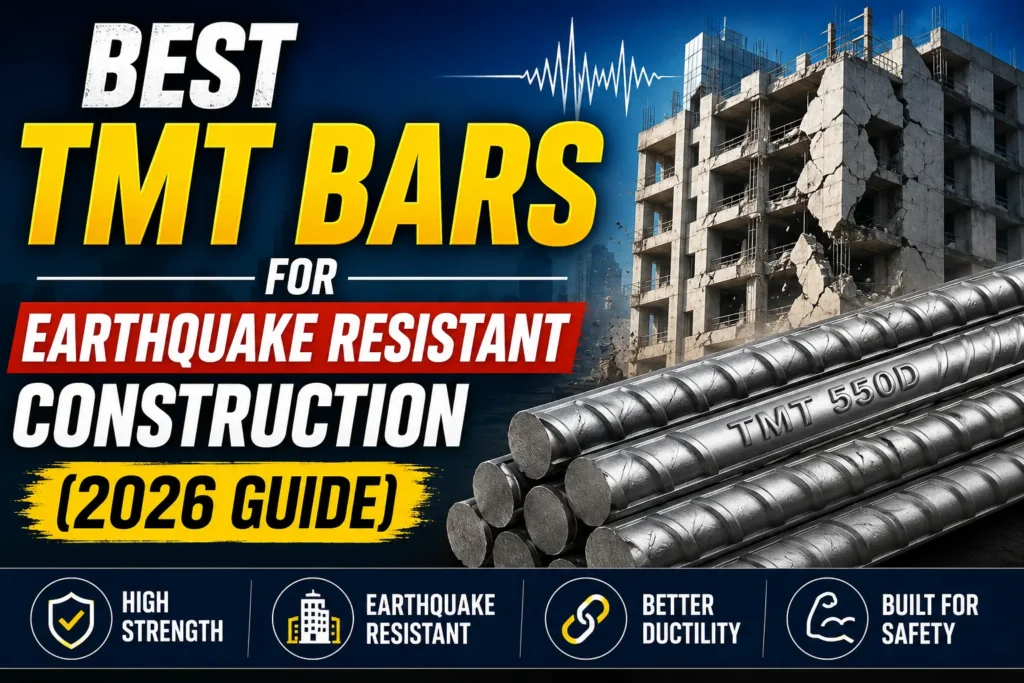
+91-9310020802 [email protected] Get A Quote Edit Template Home About us Products Contact us Latest Blogs Privacy Policy Home About us Products Contact us Latest Blogs Privacy Policy Facebook-f X-twitter Instagram Linkedin Company Overview At Pipe and Sections Pvt Ltd, we help contractors, builders, dealers, and project buyers get the latest tmt saria rate, transparent quotations, and fast delivery across India. Most Recent Posts All Posts TMT Bars Best TMT Bars for Earthquake Resistant Construction (2026 Guide) May 18, 2026/Read More Which TMT Bar is Best for RCC Construction? (2026 Guide) May 16, 2026/Read More Primary vs Secondary TMT Bars: What’s the Difference? May 15, 2026/Read More TMT Buying Guide for Contractors (2026) Fe 500, Fe 550, Fe 500D, Fe 550D, Fe 600. May 15, 2026/Read More Why TMT Prices Change Daily in India May 15, 2026/Read More How to Check TMT Bar Quality Before Buying May 13, 2026/Read More Best TMT Bar for House Construction in India (2026 Guide) May 9, 2026/Read More Fe 500 vs Fe 550 TMT: Which is Better for Construction? (2026 Guide) May 9, 2026/Read More TMT Bar Sizes Explained (8mm to 32mm Full Guide) May 8, 2026/Read More Fe 600 TMT Bars: Is It Worth It for Heavy Construction? (2026 Guide) May 7, 2026/Read More Fe 550D TMT Bars: Why Builders Prefer It (2026 Guide) May 6, 2026/Read More Fe 550 TMT Bars: Price, Strength & Project Use (2026 Guide) May 6, 2026/Read More Fe 500 TMT Bars Price, Uses & Best Applications (2026 Guide) May 5, 2026/Read More TMT Saria Rate Today in India (Live Price Update) – April 2026 May 2, 2026/Read More Load More End of Content. Tags TMT Bars (15) Best TMT Bars for Earthquake Resistant Construction (2026 Guide) Earthquake resistant construction requires high-ductility and high-strength TMT bars that can absorb seismic stress without sudden failure. In India, Fe 500D and Fe 550D earthquake resistant TMT bars are considered among the best choices for seismic-zone buildings because they offer better elongation, flexibility, crack resistance, and structural stability during earthquakes. Why Choosing the Right TMT Bar Matters in Earthquake Resistant Construction During an earthquake, buildings face sudden lateral movement, vibration, twisting forces, and dynamic structural pressure. Ordinary reinforcement bars may crack or fail under this stress if they lack proper ductility and flexibility. This is why engineers and contractors prefer specially designed earthquake resistant TMT bars for seismic construction projects. The right TMT bars help: Absorb seismic shock Reduce structural cracking Improve flexibility under stress Increase RCC bonding strength Prevent sudden structural collapse Improve long-term building safety Modern seismic-resistant construction in India now heavily depends on high-ductility reinforcement bars for both residential and commercial structures. For contractors and project buyers looking for reliable reinforcement solutions, Pipe & Sections Pvt Ltd. supplies multiple grades of TMT bars with bulk dispatch support, GST billing, and ready stock availability across India. What Makes a TMT Bar Earthquake Resistant? The most important factor in seismic-resistant reinforcement is ductility. What is Ductility? Ductility refers to the ability of a TMT bar to bend and stretch under pressure without breaking suddenly. During an earthquake: Buildings move repeatedly Reinforcement faces tension and compression Sudden load transfer occurs Structural joints experience high stress If reinforcement bars are brittle, they may snap.If reinforcement bars are ductile, they absorb energy and protect the structure. This is why ductility is critical for earthquake resistant construction. Why Ductility Matters in Seismic Construction In seismic zones, structures are designed to “flex” instead of failing rigidly. High-ductility TMT bars help in: Energy absorption Crack control Structural stability Shock resistance Better load redistribution This becomes especially important in: High-rise buildings RCC structures Bridges Multi-storey homes Industrial buildings Infrastructure projects Builders today increasingly choose ductile grades such as Fe 500D and Fe 550D because they perform better under dynamic stress conditions. If you are selecting reinforcement grades for residential or commercial projects, reading Ultimate TMT Buying Guide for Construction Projects can help you understand how different grades behave under structural loads. Fe 500D vs Fe 550D for Earthquake Resistant Construction The most commonly recommended grades for seismic construction are: Fe 500D Fe 550D Both offer improved ductility compared to standard grades. What Does “D” Mean in TMT Bars? The “D” in Fe 500D or Fe 550D stands for: High Ductility These grades are specifically designed to provide: Better elongation Improved bendability Higher seismic resistance Better weldability Enhanced structural flexibility Fe 500D TMT Bars Features High ductility Excellent bendability Better crack resistance Suitable for residential RCC structures Good earthquake resistance Best Applications Residential houses Columns Slabs Foundations Beams Fe 500D is widely preferred in seismic-prone residential construction because it balances affordability with safety. You can also explore Fe 500 vs Fe 500D TMT: Key Differences Explained to better understand the performance gap between standard and ductile grades. Fe 550D TMT Bars Features Higher yield strength Superior ductility Better load-bearing capacity Excellent fatigue resistance Suitable for heavy RCC structures Best Applications High-rise buildings Commercial projects Industrial construction Flyovers Infrastructure projects Fe 550D provides higher strength while maintaining ductility, making it highly suitable for demanding seismic applications. Builders handling large structural projects often prefer Fe 550D for improved long-term structural stability. For detailed grade comparison, check TMT Bar Grades Explained (Fe 500, Fe 550, Fe 550D & Fe 600). Fe 500D vs Fe 550D – Which is Better for Earthquake Resistant Construction? Feature Fe 500D Fe 550D Yield Strength Moderate Higher Ductility Excellent Excellent Best Use Residential Commercial & Infrastructure Cost More affordable Slightly premium Earthquake Resistance Very good Excellent Flexibility High High Structural Load Capacity Medium High Recommendation Choose Fe 500D if: You are building a house Your project is mid-scale Budget optimization matters Choose Fe 550D if: You are building high-rise structures Heavy load-bearing is required Infrastructure-level safety is needed Seismic Zone Requirements in India India is divided into seismic zones based on earthquake risk. Indian Seismic Zones Zone Risk Level Zone II Low Zone III Moderate Zone IV High Zone V Very High Regions in Zones IV and V require stronger
Which TMT Bar is Best for RCC Construction? (2026 Guide)
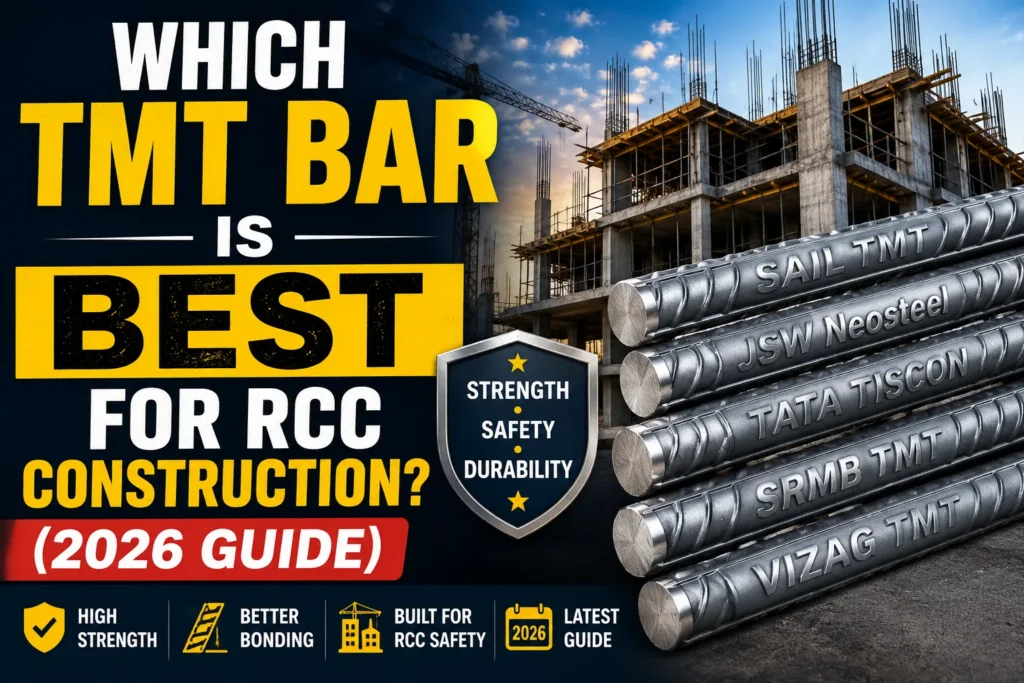
+91-9310020802 [email protected] Get A Quote Edit Template Home About us Products Contact us Latest Blogs Privacy Policy Home About us Products Contact us Latest Blogs Privacy Policy Facebook-f X-twitter Instagram Linkedin Company Overview At Pipe and Sections Pvt Ltd, we help contractors, builders, dealers, and project buyers get the latest tmt saria rate, transparent quotations, and fast delivery across India. Most Recent Posts All Posts TMT Bars Which TMT Bar is Best for RCC Construction? (2026 Guide) May 16, 2026/Read More Primary vs Secondary TMT Bars: What’s the Difference? May 15, 2026/Read More TMT Buying Guide for Contractors (2026) Fe 500, Fe 550, Fe 500D, Fe 550D, Fe 600. May 15, 2026/Read More Why TMT Prices Change Daily in India May 15, 2026/Read More How to Check TMT Bar Quality Before Buying May 13, 2026/Read More Best TMT Bar for House Construction in India (2026 Guide) May 9, 2026/Read More Fe 500 vs Fe 550 TMT: Which is Better for Construction? (2026 Guide) May 9, 2026/Read More TMT Bar Sizes Explained (8mm to 32mm Full Guide) May 8, 2026/Read More Fe 600 TMT Bars: Is It Worth It for Heavy Construction? (2026 Guide) May 7, 2026/Read More Fe 550D TMT Bars: Why Builders Prefer It (2026 Guide) May 6, 2026/Read More Fe 550 TMT Bars: Price, Strength & Project Use (2026 Guide) May 6, 2026/Read More Fe 500 TMT Bars Price, Uses & Best Applications (2026 Guide) May 5, 2026/Read More TMT Saria Rate Today in India (Live Price Update) – April 2026 May 2, 2026/Read More Load More End of Content. Tags TMT Bars (14) Which TMT Bar is Best for RCC Construction? (2026 Guide) When it comes to RCC construction, Fe 500D and Fe 550D TMT bars are considered the best choices because they offer high strength, better ductility, improved load-bearing capacity, and stronger bonding with concrete. For residential RCC work, Fe 500D is widely preferred, while Fe 550D is more suitable for commercial and heavy structural RCC projects. What is RCC Construction? RCC stands for Reinforced Cement Concrete, a construction method where steel reinforcement bars are embedded inside concrete to improve tensile strength and structural durability. Concrete is strong in compression but weak in tension. TMT bars solve this problem by handling tensile loads and improving the structural stability of buildings, slabs, beams, columns, foundations, and bridges. This is why selecting the right TMT bar for RCC construction is one of the most important decisions in any project. If you are planning residential, commercial, industrial, or infrastructure construction, choosing the correct TMT grade directly affects: Structural strength Earthquake resistance Crack resistance Long-term durability Load-bearing capacity Safety standards For buyers looking to understand TMT grades in detail, read our detailed guide on TMT Bar Grades Explained (Fe 500, Fe 550, Fe 550D & Fe 600). Why TMT Bars Matter in RCC Construction TMT bars are the backbone of RCC structures. Without proper reinforcement, concrete structures can crack, bend, or fail under heavy loads. Modern TMT bars are manufactured using thermo-mechanical treatment technology, which provides: High tensile strength Better flexibility Corrosion resistance Strong bonding with cement Heat resistance Seismic resistance In RCC structures, these properties are extremely important because reinforcement bars constantly face tension, load transfer, thermal expansion, and environmental stress. This is why contractors and structural engineers prefer high-quality TMT bars for RCC applications. For current market rates and size-wise pricing, check our TMT Bar Price Today in India (2026 Complete Guide). Best TMT Grades for RCC Construction Different RCC projects require different TMT grades depending on structural load and design requirements. Fe 500 TMT Bars Fe 500 is one of the most commonly used grades for residential RCC construction. Best for: House construction Slabs Beams Columns Small commercial projects Benefits: Good strength-to-cost ratio Easily available Suitable for normal RCC work Cost-effective for residential structures However, for projects requiring higher ductility and earthquake resistance, Fe 500D performs better. Learn more in our detailed Fe 500 TMT Bars: Price, Uses & Best Applications guide. Fe 500D TMT Bars Fe 500D is considered one of the best TMT grades for RCC structures because it provides higher ductility along with strong load-bearing performance. Best for: RCC slabs Earthquake-prone zones Residential foundations Multi-floor structures Major advantages: Better elongation Improved flexibility Reduced crack formation Better seismic resistance This grade is widely used in modern RCC construction because of its balanced strength and flexibility. Fe 550 TMT Bars Fe 550 offers higher yield strength compared to Fe 500. Best for: Commercial RCC work Industrial projects Heavy structural frameworks High-load columns Benefits: Higher tensile strength Reduced steel consumption Better structural performance However, higher strength also means slightly lower ductility compared to D-grade variants. For comparison, read our detailed Fe 500 vs Fe 550 TMT: Which is Better? article. Fe 550D TMT Bars Fe 550D is among the most preferred grades for modern RCC structures. Best for: High-rise buildings Commercial RCC structures Bridges Flyovers Industrial foundations Why builders prefer it: High strength + high ductility Excellent seismic performance Better fatigue resistance Strong bonding with concrete Contractors working on premium RCC projects often choose Fe 550D due to its long-term structural reliability. You can also explore our detailed Fe 550D TMT Bars: Why Builders Prefer It guide. Fe 500 vs Fe 550 for RCC Construction One of the most common questions among contractors and buyers is whether Fe 500 or Fe 550 is better for RCC work. Fe 500 vs Fe 550 Comparison Table Feature Fe 500 Fe 550 Yield Strength 500 MPa 550 MPa Ductility Higher Moderate Cost Lower Slightly higher Best Use Residential RCC Commercial RCC Load Capacity Medium High Flexibility Better Stronger Which One Should You Choose? Choose Fe 500 if: You are building a house Budget optimization matters Project load is moderate RCC work is residential Choose Fe 550 if: Structure has heavy load requirements Commercial strength is required Large spans are involved Industrial applications are planned For modern RCC applications, many structural consultants now recommend Fe 500D or Fe 550D because they
Primary vs Secondary TMT Bars: What’s the Difference?
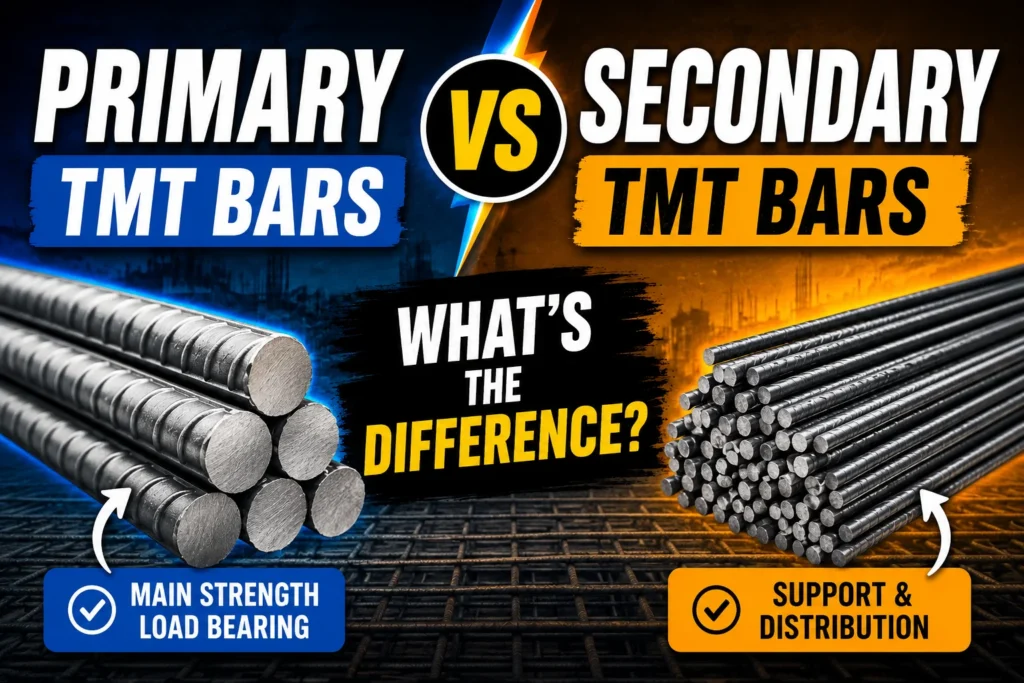
+91-9310020802 [email protected] Get A Quote Edit Template Home About us Products Contact us Latest Blogs Privacy Policy Home About us Products Contact us Latest Blogs Privacy Policy Facebook-f X-twitter Instagram Linkedin Company Overview At Pipe and Sections Pvt Ltd, we help contractors, builders, dealers, and project buyers get the latest tmt saria rate, transparent quotations, and fast delivery across India. Most Recent Posts All Posts TMT Bars How to Reduce Construction Cost with the Right TMT Bars (2026 Guide) May 18, 2026/Read More TMT Bars for High-Rise Buildings: Best Grades & Sizes May 18, 2026/Read More Best TMT Bars for Earthquake Resistant Construction (2026 Guide) May 18, 2026/Read More Which TMT Bar is Best for RCC Construction? (2026 Guide) May 16, 2026/Read More Primary vs Secondary TMT Bars: What’s the Difference? May 15, 2026/Read More TMT Buying Guide for Contractors (2026) Fe 500, Fe 550, Fe 500D, Fe 550D, Fe 600. May 15, 2026/Read More Why TMT Prices Change Daily in India May 15, 2026/Read More How to Check TMT Bar Quality Before Buying May 13, 2026/Read More Best TMT Bar for House Construction in India (2026 Guide) May 9, 2026/Read More Fe 500 vs Fe 550 TMT: Which is Better for Construction? (2026 Guide) May 9, 2026/Read More TMT Bar Sizes Explained (8mm to 32mm Full Guide) May 8, 2026/Read More Fe 600 TMT Bars: Is It Worth It for Heavy Construction? (2026 Guide) May 7, 2026/Read More Fe 550D TMT Bars: Why Builders Prefer It (2026 Guide) May 6, 2026/Read More Load More End of Content. Tags TMT Bars (17) Primary vs Secondary TMT Bars: What’s the Difference? Choosing between primary and secondary TMT bars is critical for construction quality, structural safety, and long-term durability. Primary TMT bars are manufactured by integrated steel plants using controlled raw materials and advanced processes, while secondary TMT bars are generally produced from recycled steel in smaller rolling mills. Primary TMT bars usually offer better consistency, strength, ductility, and reliability for residential, commercial, and infrastructure projects. TMT prices are influenced by multiple market factors including raw material costs, steel demand, transportation expenses, and production trends. Read our detailed guide on why TMT prices change daily in India to better understand current steel market movements. Introduction TMT bars are one of the most important materials used in modern construction. Whether it is a residential house, commercial building, warehouse, bridge, or industrial project, the quality of reinforcement steel directly impacts structural strength and safety. One of the most common questions buyers ask before purchasing reinforcement steel is: “What is the difference between primary and secondary TMT bars?” This comparison is extremely important because many contractors, builders, and individual homeowners often choose TMT bars based only on price without understanding the actual difference in quality, manufacturing process, durability, and performance. In today’s construction market, both primary and secondary TMT bars are widely available. However, selecting the right type depends on project requirements, load-bearing needs, budget, and long-term structural expectations. At Pipe & Sections Pvt Ltd, contractors, builders, and infrastructure buyers frequently seek guidance on selecting the right TMT category for residential, commercial, and industrial construction projects. Understanding the real difference between primary and secondary TMT bars helps buyers avoid low-quality material risks and make informed purchasing decisions. What is Primary TMT? Primary TMT bars are manufactured by large integrated steel manufacturers using high-quality raw materials and controlled production systems. These TMT bars are generally produced from: Iron ore Sponge iron Billets produced internally Controlled metallurgy processes Primary steel manufacturers follow strict quality standards and advanced production technologies to maintain consistent chemical composition, strength, ductility, and durability. Primary TMT bars are usually manufactured in: Large integrated steel plants Automated rolling mills Thermo-mechanical treatment facilities These manufacturers maintain proper testing procedures and quality certifications during production. If you are planning construction in an earthquake-prone area, this comprehensive article on “Best TMT Bars for Earthquake Resistant Construction (2026 Guide)” helps you understand the importance of Fe 500D and Fe 550D TMT bars for better seismic resistance and structural stability. Key Characteristics of Primary TMT Bars 1. Consistent Quality Primary TMT bars maintain uniform mechanical and chemical properties throughout production batches. 2. Better Strength They generally provide superior yield strength and tensile strength. 3. Higher Ductility Primary TMT bars perform better during earthquakes and heavy-load applications. 4. Better Corrosion Resistance Controlled chemical composition improves long-term durability. 5. Reliable Testing Standards Most primary manufacturers provide: Mill Test Certificates ISI certifications Standardized quality reports What is Secondary TMT? Secondary TMT bars are generally produced by smaller rolling mills using recycled steel scrap, purchased billets, or induction furnace material. These manufacturers may not always have fully integrated steelmaking facilities. Secondary steel production commonly involves: Scrap melting Purchased billets Re-rolling processes Smaller-scale production systems Secondary TMT bars are widely used because they are comparatively cheaper than primary TMT bars. However, quality consistency can vary significantly depending on the manufacturer and production standards. Key Characteristics of Secondary TMT Bars 1. Lower Cost Secondary TMT bars are usually more affordable. 2. Variable Quality Strength and chemical consistency may differ between batches. 3. Mixed Raw Materials Production often depends on recycled steel and external billet sourcing. 4. Limited Quality Control Smaller mills may have less advanced testing systems. 5. Budget-Friendly Option Often preferred for: Small projects Temporary structures Low-budget construction Manufacturing Difference Between Primary and Secondary TMT Bars The manufacturing process is one of the biggest differences between primary and secondary TMT bars. Primary TMT Manufacturing Process Primary manufacturers usually follow: Iron ore processing Sponge iron production Steelmaking in blast furnaces or electric arc furnaces Billet casting Controlled rolling Thermo-mechanical treatment Automated cooling systems Quality testing This integrated process ensures: Better metallurgy Consistent chemistry Uniform strength Improved ductility Secondary TMT Manufacturing Process Secondary manufacturers commonly use: Scrap collection Scrap melting Billet purchasing Re-rolling Basic heat treatment Limited testing Since raw material quality may vary, final product consistency can also fluctuate. Strength Comparison: Primary vs Secondary TMT Strength is one of the most important factors in reinforcement
TMT Buying Guide for Contractors (2026) Fe 500, Fe 550, Fe 500D, Fe 550D, Fe 600.
+91-9310020802 [email protected] Get A Quote Edit Template Home About us Products Contact us Latest Blogs Privacy Policy Home About us Products Contact us Latest Blogs Privacy Policy Facebook-f X-twitter Instagram Linkedin Company Overview At Pipe and Sections Pvt Ltd, we help contractors, builders, dealers, and project buyers get the latest tmt saria rate, transparent quotations, and fast delivery across India. Most Recent Posts All Posts TMT Bars How to Reduce Construction Cost with the Right TMT Bars (2026 Guide) May 18, 2026/Read More TMT Bars for High-Rise Buildings: Best Grades & Sizes May 18, 2026/Read More Best TMT Bars for Earthquake Resistant Construction (2026 Guide) May 18, 2026/Read More Which TMT Bar is Best for RCC Construction? (2026 Guide) May 16, 2026/Read More Primary vs Secondary TMT Bars: What’s the Difference? May 15, 2026/Read More TMT Buying Guide for Contractors (2026) Fe 500, Fe 550, Fe 500D, Fe 550D, Fe 600. May 15, 2026/Read More Why TMT Prices Change Daily in India May 15, 2026/Read More How to Check TMT Bar Quality Before Buying May 13, 2026/Read More Best TMT Bar for House Construction in India (2026 Guide) May 9, 2026/Read More Fe 500 vs Fe 550 TMT: Which is Better for Construction? (2026 Guide) May 9, 2026/Read More TMT Bar Sizes Explained (8mm to 32mm Full Guide) May 8, 2026/Read More Fe 600 TMT Bars: Is It Worth It for Heavy Construction? (2026 Guide) May 7, 2026/Read More Fe 550D TMT Bars: Why Builders Prefer It (2026 Guide) May 6, 2026/Read More Load More End of Content. Tags TMT Bars (17) TMT Buying Guide for Contractors (2026) Contractors buying TMT bars in 2026 need to focus on more than just price. The right TMT grade, accurate weight, original material quality, proper logistics, and reliable supplier support directly affect project safety, construction cost, and long-term durability. Choosing a trusted supplier like Pipe & Sections Pvt Ltd. helps contractors secure quality TMT bars with transparent pricing, GST billing, ready stock, and bulk dispatch support across India. Before purchasing reinforcement steel for residential or commercial construction, it is important to understand which TMT grades work best for RCC structures. Our Which TMT Bar is Best for RCC Construction? guide explains everything in detail. Introduction TMT bars are one of the most important materials used in construction projects. Whether it is residential construction, commercial buildings, industrial structures, bridges, warehouses, or infrastructure projects, the strength of the structure depends heavily on the quality of TMT bars used. In 2026, contractors are facing rising steel prices, fluctuating market conditions, fake material risks, and project deadline pressure. Because of this, buying TMT bars is no longer just about getting the lowest rate. Contractors now need a proper TMT buying strategy that balances quality, pricing, logistics, durability, and supplier reliability. This complete TMT buying guide explains how contractors can choose the right TMT bars, avoid low-quality material, verify weight accuracy, negotiate better prices, and plan bulk procurement effectively. Contractors who understand steel market trends can often optimize procurement costs more effectively. Learn why TMT prices change daily in India and how market conditions affect bulk steel purchasing decisions. Choosing the Right TMT Grade One of the biggest mistakes contractors make is selecting the wrong TMT grade for the project. Every grade has different strength and application suitability. Before selecting steel for tall structures, it is important to understand the right grade, load-bearing capacity, and earthquake resistance. This detailed guide on TMT Bars for High-Rise Buildings also explains how to choose the right best TMT bars for construction for long-term structural safety. What Does TMT Grade Mean? The “Fe” value in TMT bars represents the minimum yield strength of the steel. For example: Fe 500 = 500 N/mm² yield strength Fe 550 = 550 N/mm² yield strength Fe 550D = 550 N/mm² with higher ductility Fe 600 = 600 N/mm² yield strength Higher grades offer better load-bearing capacity but may not be necessary for every project. Fe 500 TMT Bars Fe 500 is one of the most commonly used grades in India. Best For: Residential construction Individual houses Small commercial projects Slabs and beams Advantages: Affordable pricing Good strength balance Easy availability Suitable for general RCC work Most contractors prefer Fe 500 for standard residential construction because it offers good structural strength at a practical cost. Fe 550 TMT Bars Fe 550 bars are stronger than Fe 500 and are suitable for heavy-load applications. Best For: Commercial buildings High-rise structures Industrial projects Heavy RCC structures Advantages: Higher tensile strength Better load handling Reduced steel consumption in some cases Fe 550D TMT Bars The “D” stands for ductility. Fe 550D bars provide both high strength and flexibility, making them suitable for structures requiring earthquake resistance and stress absorption. Best For: Seismic zones Bridges Columns Infrastructure projects Heavy structural work Why Contractors Prefer Fe 550D: Better elongation Improved flexibility Reduced cracking risk Better long-term structural performance Fe 600 TMT Bars Fe 600 bars are high-strength reinforcement bars mainly used in infrastructure and industrial projects. Best For: Flyovers Industrial foundations Mega infrastructure projects Heavy engineering structures Fe 600 is generally not required for standard residential work because it increases project cost. Choosing the Right TMT Size Selecting the correct TMT bar size is equally important. Wrong size selection can increase construction cost or weaken the structure. Standard TMT Sizes in India TMT Size Common Use 8mm Stirrups and rings 10mm Slabs and light RCC work 12mm Residential slabs and beams 16mm Columns and beams 20mm Heavy columns and foundations 25mm Industrial structures 32mm Infrastructure and large RCC work Which TMT Size is Best for House Construction? For most residential projects: 10mm and 12mm → slabs 16mm → columns and beams 20mm → foundations Contractors should always follow structural engineer recommendations before finalizing sizes. Common Size Selection Mistakes 1. Using Larger Sizes Unnecessarily This increases project cost without improving performance significantly. 2. Ignoring Structural Drawings Improper size selection can affect load distribution. 3. Buying Mixed Sizes Without Planning Poor inventory planning leads
Why TMT Prices Change Daily in India

+91-9310020802 [email protected] Get A Quote Edit Template Home About us Products Contact us Latest Blogs Privacy Policy Home About us Products Contact us Latest Blogs Privacy Policy Facebook-f X-twitter Instagram Linkedin Company Overview At Pipe and Sections Pvt Ltd, we help contractors, builders, dealers, and project buyers get the latest tmt saria rate, transparent quotations, and fast delivery across India. Most Recent Posts All Posts TMT Bars Primary vs Secondary TMT Bars: What’s the Difference? May 15, 2026/Read More TMT Buying Guide for Contractors (2026) Fe 500, Fe 550, Fe 500D, Fe 550D, Fe 600. May 15, 2026/Read More Why TMT Prices Change Daily in India May 15, 2026/Read More How to Check TMT Bar Quality Before Buying May 13, 2026/Read More Best TMT Bar for House Construction in India (2026 Guide) May 9, 2026/Read More Fe 500 vs Fe 550 TMT: Which is Better for Construction? (2026 Guide) May 9, 2026/Read More TMT Bar Sizes Explained (8mm to 32mm Full Guide) May 8, 2026/Read More Fe 600 TMT Bars: Is It Worth It for Heavy Construction? (2026 Guide) May 7, 2026/Read More Fe 550D TMT Bars: Why Builders Prefer It (2026 Guide) May 6, 2026/Read More Load More End of Content. Tags TMT Bars (13) Why TMT Prices Change Daily in India TMT bar prices in India change daily because steel manufacturing costs are directly affected by fluctuations in raw materials, iron ore, coal, demand from the construction sector, transportation costs, global commodity markets, and government policies. Even small changes in these factors can increase or decrease TMT rates across local and national markets. The Indian steel market is highly dynamic. Builders, contractors, infrastructure companies, and dealers regularly monitor TMT rates because steel is one of the largest cost components in construction projects. Whether you are building a house, commercial complex, warehouse, or infrastructure project, understanding why TMT prices fluctuate daily helps you make smarter purchasing decisions. As a trusted steel supplier, Pipe & Sections Pvt Ltd works closely with contractors, dealers, and project buyers across India and regularly tracks market trends to provide transparent TMT pricing and reliable bulk supply support. Understanding market fluctuations is important, but smart procurement strategy matters equally. Read our complete TMT Buying Guide for Contractors to learn how builders and contractors reduce costs while purchasing TMT bars in bulk. What Are TMT Bars? TMT (Thermo-Mechanically Treated) bars are high-strength reinforcement steel bars used in RCC construction. These bars are manufactured through a special heat treatment process that improves strength, ductility, weldability, and earthquake resistance. TMT bars are commonly available in grades such as: Fe 500 Fe 500D Fe 550 Fe 550D Fe 600 These bars are widely used in: Residential construction Commercial buildings Infrastructure projects Bridges Industrial foundations Warehouses RCC structures Since TMT bars are made from steel billets and iron ore-based raw materials, their prices are highly sensitive to market conditions. Why TMT Prices Change Daily in India There is no single reason behind TMT price fluctuation. The steel market works through a combination of raw material pricing, manufacturing costs, logistics, demand cycles, and global economic activity. The major factors affecting TMT bar prices are: Raw material cost Iron ore and coal prices Demand and supply balance Seasonal construction demand Transportation and logistics cost Global steel market movement Government duties and taxation Energy and electricity cost Brand positioning and quality Market speculation and inventory trends Let’s understand each factor in detail. 1. Raw Material Impact on TMT Prices Raw materials are the biggest factor behind daily TMT price movement. The primary raw materials used in steel manufacturing include: Iron ore Sponge iron Steel scrap Billets Coking coal Ferro alloys When raw material prices increase, steel manufacturers automatically raise TMT prices to maintain production margins. For example, iron ore prices in India increased significantly during recent market revisions by NMDC, directly impacting steel manufacturing costs. Steel billets alone account for a major portion of TMT manufacturing costs. Even a small increase in billet pricing can create a substantial change in finished TMT bar rates. This is why contractors often notice daily fluctuations in steel prices even when local demand appears stable. 2. Iron Ore & Coal Prices Directly Affect Steel Rates Iron ore and coal are the backbone of steel manufacturing. Iron Ore Impact Iron ore is the primary raw material used in steel production. When mining companies increase ore prices, steel plants experience immediate production cost pressure. In 2026, NMDC revised iron ore prices multiple times, increasing lump and fines pricing due to market demand and production conditions. Recent market revisions showed: Material Approx. Revised Price Baila Lump Ore ₹5,500/ton Baila Fines ₹4,700/ton These changes directly influence billet prices and eventually TMT rates. Coal & Energy Cost Impact Steel manufacturing requires enormous amounts of energy. Coal is used in: Blast furnaces Sponge iron manufacturing Rolling mills Thermal processing If coal prices increase internationally, steel production becomes more expensive. Energy costs, fuel prices, and industrial electricity tariffs also increase overall steel manufacturing expenses. Many steel plants pass these costs directly into finished TMT bar pricing. 3. Demand-Supply Effect in the Steel Market Like every commodity market, TMT prices heavily depend on demand and supply. When Demand Increases TMT prices generally rise during periods of: High construction activity Government infrastructure projects Real estate growth Industrial expansion Highway and bridge projects When demand exceeds supply, prices move upward quickly. When Demand Slows TMT prices may decline during: Slow construction seasons Monsoon periods Economic slowdowns Reduced infrastructure spending Inventory oversupply This demand-supply cycle is one of the biggest reasons why contractors see price changes every few days. 4. Seasonal Construction Demand Construction activity in India changes seasonally, and this strongly impacts TMT demand. Peak Construction Seasons Demand usually rises during: October to March Pre-monsoon construction cycles Government project execution periods During these months: Builders buy aggressively Contractors increase inventory Infrastructure work accelerates As a result, steel prices often increase. Monsoon Impact During heavy monsoon periods: Construction slows down Demand reduces Site work gets delayed Bulk procurement
How to Check TMT Bar Quality Before Buying
+91-9310020802 [email protected] Get A Quote Edit Template Home About us Products Contact us Latest Blogs Privacy Policy Home About us Products Contact us Latest Blogs Privacy Policy Facebook-f X-twitter Instagram Linkedin Company Overview At Pipe and Sections Pvt Ltd, we help contractors, builders, dealers, and project buyers get the latest tmt saria rate, transparent quotations, and fast delivery across India. Most Recent Posts All Posts TMT Bars How to Check TMT Bar Quality Before Buying May 13, 2026/Read More Best TMT Bar for House Construction in India (2026 Guide) May 9, 2026/Read More Fe 500 vs Fe 550 TMT: Which is Better for Construction? (2026 Guide) May 9, 2026/Read More TMT Bar Sizes Explained (8mm to 32mm Full Guide) May 8, 2026/Read More Fe 600 TMT Bars: Is It Worth It for Heavy Construction? (2026 Guide) May 7, 2026/Read More Fe 550D TMT Bars: Why Builders Prefer It (2026 Guide) May 6, 2026/Read More Fe 550 TMT Bars: Price, Strength & Project Use (2026 Guide) May 6, 2026/Read More Fe 500 TMT Bars Price, Uses & Best Applications (2026 Guide) May 5, 2026/Read More TMT Saria Rate Today in India (Live Price Update) – April 2026 May 2, 2026/Read More Load More End of Content. Tags TMT Bars (10) How to Check TMT Bar Quality Before Buying TMT bar quality directly affects the strength, durability, and safety of any construction project. Before buying TMT bars, buyers should check the grade, weight, ISI mark, rib pattern, flexibility, bend strength, and test certificate to ensure the material meets proper construction standards and long-term structural requirements. Introduction TMT (Thermo Mechanically Treated) bars are one of the most important materials used in modern construction. Whether you are building a house, commercial complex, warehouse, factory, bridge, or infrastructure project, the quality of TMT bars determines the overall structural strength and safety of the construction. Many buyers focus only on TMT price and ignore quality verification. However, poor-quality or duplicate TMT bars can lead to serious structural issues, cracks, corrosion problems, reduced load-bearing capacity, and higher maintenance costs in the future. In today’s construction market, buyers must know how to identify original and high-quality TMT bars before placing bulk orders. Contractors, builders, engineers, fabricators, and project buyers now prefer technically verified and certified TMT products to avoid construction risks. At Pipe & Sections Pvt Ltd, buyers regularly ask how to verify TMT quality before purchasing material for residential, commercial, and industrial projects. This guide explains the latest methods, checks, standards, and practical buying tips to help buyers make safe and informed decisions. Why TMT Bar Quality Matters The quality of TMT bars directly impacts: Structural safety Earthquake resistance Load-bearing capacity Corrosion resistance Construction lifespan Crack prevention Long-term maintenance cost Low-quality TMT bars may initially appear cheaper, but they often create serious long-term structural risks. Major Problems Caused by Poor TMT Quality 1. Reduced Structural Strength Low-grade steel cannot handle heavy structural loads effectively. 2. Cracks in RCC Structures Poor bonding between concrete and TMT bars can cause cracks in slabs, beams, and columns. 3. Corrosion Issues Substandard TMT bars are more vulnerable to rust and moisture damage. 4. Reduced Earthquake Resistance Low ductility reduces the structure’s ability to absorb seismic stress. 5. Higher Maintenance Cost Weak reinforcement increases future repair expenses. This is why experienced contractors and builders always verify TMT quality before procurement. Visual Inspection Checklist for TMT Bars The first step in checking TMT quality is visual inspection. Even before laboratory testing, buyers can identify many quality indicators through simple physical checks. 1. Check Surface Finish High-quality TMT bars usually have: Smooth finish Uniform rib pattern Proper branding marks No visible cracks No scaling defects Avoid bars with: Uneven surface Visible rust flakes Cracks Excessive scaling Poor finishing 2. Check Rib Pattern Ribs improve bonding between concrete and steel. Good TMT bars should have: Uniform rib spacing Consistent rib depth Clear rib design Poor rib patterns reduce concrete grip and structural stability. 3. Verify Brand Marking Original TMT bars normally contain: Manufacturer name Grade marking ISI marking Size information If branding appears unclear or inconsistent, buyers should verify authenticity before purchasing. 4. Check Rust Level Light surface rust may occur during storage, but excessive corrosion indicates poor handling or low-quality steel. Avoid bars with: Deep rust layers Pitting corrosion Surface peeling Bend Test Explanation The bend test is one of the simplest and most effective ways to check TMT flexibility and ductility. High-quality TMT bars should bend without cracking. How Bend Test Works The bar is bent to a certain angle and then inspected for: Surface cracks Breakage Brittleness Good-quality TMT bars maintain flexibility even after bending. Why Bend Strength Matters Construction structures constantly experience stress from: Load movement Thermal expansion Earthquakes Vibrations Flexible TMT bars absorb stress more effectively. Reverse Bend Test In advanced testing, bars are: Bent Heated Rebent If cracks appear, the material quality may be poor. Weight Verification of TMT Bars Weight verification is one of the most important practical checks during TMT procurement. Many low-quality or duplicate products fail weight standards. Standard TMT Weight Formula Useful formula for contractors and buyers: Weight per meter=D2162text{Weight per meter} = frac{D^2}{162}Weight per meter=162D2 Where: D = Diameter of TMT bar in mm Example For 12mm TMT bar: 122162≈0.89 kg/mfrac{12^2}{162} approx 0.89 text{kg/m}162122≈0.89 kg/m Standard TMT Weight Chart Size Approx Weight Per Meter 8mm 0.395 kg 10mm 0.617 kg 12mm 0.89 kg 16mm 1.58 kg 20mm 2.47 kg 25mm 3.85 kg 32mm 6.31 kg Why Weight Verification is Important Underweight TMT bars may indicate: Poor manufacturing Material compromise Lower steel quantity Reduced strength Always compare supplied weight with standard charts. At Pipe & Sections Pvt Ltd, bulk buyers often request proper weight verification before dispatch to ensure accurate project estimation and structural reliability. ISI Mark Check ISI certification is one of the most important indicators of TMT quality in India. The ISI mark confirms compliance with BIS standards. What is ISI Certification? ISI certification is issued under: Bureau of Indian Standards (BIS) It ensures: Proper manufacturing standards Quality control